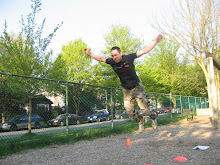
For roller derby athletes (and others) in the Vancouver, BC area who want to pick up an extra conditioning session on Sundays, learn about training with bodyweight and minimal equipment: check out the new Amazing Sunday Conditioning Studio.
These sessions begin, this Sunday, April 19 and will be ongoing on Sunday afternoons at 4.
Hope to see you there!
http://www.terminalcitytraining.com/sunday-conditioning-studio.html
Thursday, April 16, 2009

Thursday, March 19, 2009
Built for "Go" not "Show"
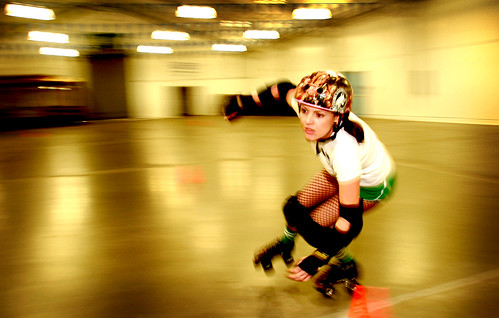
Walk into a gym anywhere any evening and what are the "dudes" usually training? Chest, biceps....ummm... and a little bit of something else for good measure. Call them the mirror muscles or the beach muscles or whatever you want. As a roller derby competitor they won't get you skating much faster. They won't be playing a significant role in injury prevention either.
Not that you want to ignore the front of your body but it makes much more sense to focus on developing your posterior chain, your "go muscles." And just what is the "posterior chain" you might ask? Simply put: the backside of your body but for our purposes here we will narrow this down a bit to the hamstrings, glutes and low back.
Your hamstrings are responsible for flexing your knees.
Your glutes (a.k.a bum) have a number of functions. They extend your hips, abduct your legs (lift them away from body's centre) and allow external hip rotation.
Your low back (spinal erectors) keeps you upright.
Happily there are a lot of exercises to choose from when training these muscles. Below is a far from comprehensive list. Some are pretty well-known and others may seem cryptic. Get to know them, use them regularly, and watch your strength and power increase, and in all the right places!
-glute ham raises (if you are lucky enough to have a GHR bench in your gym or you have built one for yourself
-deadlifts of all sorts
-back extensions
-reverse hypers
-sled dragging
-Olympic lifts (technical and difficult to learn)
-various "strongman" training methods ("strongwomen" can use them too!)
-good mornings
-lunges
-step-ups
-pull-throughs (with bands or cables)
-various movements with kettlebells, swings being the best place to start.
Work hard and enjoy the training!
image credit: Terrence McNally http://www.flickr.com/photos/terrencemcnally/
Thursday, March 5, 2009
Will Strength Training Make Me Bulky?
Will strength training make me bulky? I get this question from women all the time. I think it is largely fueled by photos of female bodybuilders.
If I could state the answer any more clearly I would but I think I can reduce it to one word: "no."
Women, on average, have 1/10th the testosterone of men. This is more or less the bottom line. The image of huge muscular women that many fear is almost always a drug-fueled aesthetic.
The good news is that women can get much stronger through strength training than they are in their untrained state. This can significantly aid performance as well as making one more resistant to injury.
If you are a highly unusual genetic specimen and find yourself getting truly "bulky" then you can choose to stop training. The training effect does reverse over time.
If I could state the answer any more clearly I would but I think I can reduce it to one word: "no."
Women, on average, have 1/10th the testosterone of men. This is more or less the bottom line. The image of huge muscular women that many fear is almost always a drug-fueled aesthetic.
The good news is that women can get much stronger through strength training than they are in their untrained state. This can significantly aid performance as well as making one more resistant to injury.
If you are a highly unusual genetic specimen and find yourself getting truly "bulky" then you can choose to stop training. The training effect does reverse over time.
Thursday, February 26, 2009
Think of Yourself as an Athlete - and Then Train Like One.

Flat track roller derby is a dangerous sport. First of all there is the contact: women are trying to knock each other around and down on the track, and some play dirty. Secondly you are competing on a very hard surface. Thirdly, and not least importantly, this is all taking place on roller skates.
Many derby competitors are in their thirties and older, come from decidedly non-athletic backgrounds, and enjoy the raucous partying that comes along with the roller derby subculture.
A sincere commitment to strengthening and conditioning oneself and one’s teammates makes a great deal of sense in this situation. This means a commitment to pursuing athletic goals outside of practice time. It means living a more athletic lifestyle. This all starts with a change in mindset.
The change of mindset that I am advocating is to think of yourself as an athlete.
Being an athlete does not preclude partying. What it does demand is physical and mental preparation, attention to nutrition, enough sleep, and amongst other things a lifestyle that allows you to recover from demanding training and which engenders solid performance. As a roller derby athlete, seeing as you are involved in a punishing sport, the risks of ignoring these basic considerations deserves deep consideration.
You are an athlete in a contact sport. You’ve probably seen the injuries, heard the stories, felt the thrill of danger. Football players, rugby players, wrestlers, boxers, MMA fighters are all expected to train outside of formal sessions. They all must take their strength, fitness and mental readiness seriously. The risks you share are not dissimilar.
During the off-season it is important to develop your general athleticism, your capacity for strength and power, your mobility, your conditioning, and so on. Because you are not attending and recovering from derby-specific training sessions it is important to do this work three or more times weekly whenever possible.
As team practices and the season begins it is important to maintain the strength, power and other qualities which you worked so hard hand during the off-season. You will not be able to hit the supplementary sessions as frequently but try for twice weekly, or at least once. Plan your training around your derby-specific sessions and your bouts. You must have adequate recovery so that you are able to develop the technical aspects of your game and so that you are feeling buoyant and ready to rumble as your bouts approach.
Take a little bit of down time after your season, just enough to feel fresh again. Then begin another cycle of developing yourself to your athletic potential. If you work harder and more intelligently than your opponents then not only will you be more resistant to injury but you will be more likely to dominate the track.
Subscribe to:
Posts (Atom)

 Posts
Posts